

How to Build a Stylish Home Office for a Golfer
A golfer's home office does not need a wall of flags, a rack of clubs, and a novelty putting cup under the desk. Those choices may communicate the interest quickly, but they can also make a working room feel like equipment storage.
A more useful office supports concentration first. Golf appears through art, materials, geometry, personal objects, and an optional practice function that fits the room instead of interrupting it.
The result should work on a video call, during a focused afternoon, and when a putter comes out for ten quiet minutes. This guide builds that room in layers, beginning with work and ending with the hidden golf.

Define the office's real jobs
List everything the room must support: computer work, calls, reading, storage, creative thinking, occasional guests, and perhaps indoor putting. Rank those uses. A desk that looks dramatic but creates glare is not successful; neither is a practice line that blocks the door.
Use the workday to guide the floor plan:
- Where does natural light fall in the morning and afternoon?
- What appears behind the desk on video calls?
- Which path must remain open to the door or closet?
- Where can a long visual line exist without crossing a chair's movement?
Once these functions are settled, golf can enter the room without fighting them.
Build a restrained material palette
Golf has a useful design vocabulary beyond green. Consider dark metal, warm wood, leather, brushed brass, wool, cream, charcoal, and controlled accents of red or blue.
Choose two primary materials and one accent. For example:
- Black metal, walnut, and bronze
- Light oak, cream, and muted green
- Charcoal, leather, and deep red
- Walnut, navy, and warm brass
Repeat the accent in no more than three places: a lamp detail, a frame, and a small desk object. This creates cohesion without making the office look branded.
Place the desk for focus and a clean background
Whenever possible, avoid putting the brightest window directly behind the monitor or behind your head on calls. A side-lighting position usually creates more comfortable working light and a more balanced screen image.
Design the camera background as a real wall, not a temporary video-call set. One large artwork, a low cabinet, and a plant can look more composed than a crowded shelf. If golf appears, let one piece carry the reference.
A framed course landscape or architectural routing plan works because it is visually credible even to someone who does not recognize the course.
Choose golf art that behaves like art
Look for strong composition, meaningful subject, and appropriate scale. A wide course photograph can reinforce the horizontal line of a credenza. A vertical image may suit the narrow wall beside a bookcase. A topographic map can add structure to a minimalist office.
Avoid filling every wall. Golf art gains importance when it is given space. If a scorecard represents a personal story, frame it with one photograph and a generous mat instead of surrounding it with unrelated memorabilia.
Add storage before adding display
The fastest way to make a golf office feel unfinished is to leave gloves, balls, towels, and shipping boxes visible. Provide closed storage for ordinary items first.
A cabinet, credenza, or storage bench can hold:
- A small practice kit
- Headphones and chargers
- Golf books not currently in use
- Shoes or soft goods
- Printer supplies and office equipment
Open shelves should contain only objects that improve the room: a few books, one meaningful ball or marker, a sculptural item, and perhaps a small plant. Storage is not the enemy of personality; it is what allows personality to be seen.
Create a putting line that does not interrupt work
The side of the desk, the path behind a chair, or a clear wall edge may support a short putting line. Confirm that the putter can move without contacting furniture and that a missed ball cannot reach a stairway, glass door, or cable cluster.
The most useful line is one that stays clear through the workday. If a floor mat must be unpacked, flattened, and removed after every session, it may become a weekend activity rather than a daily reset.
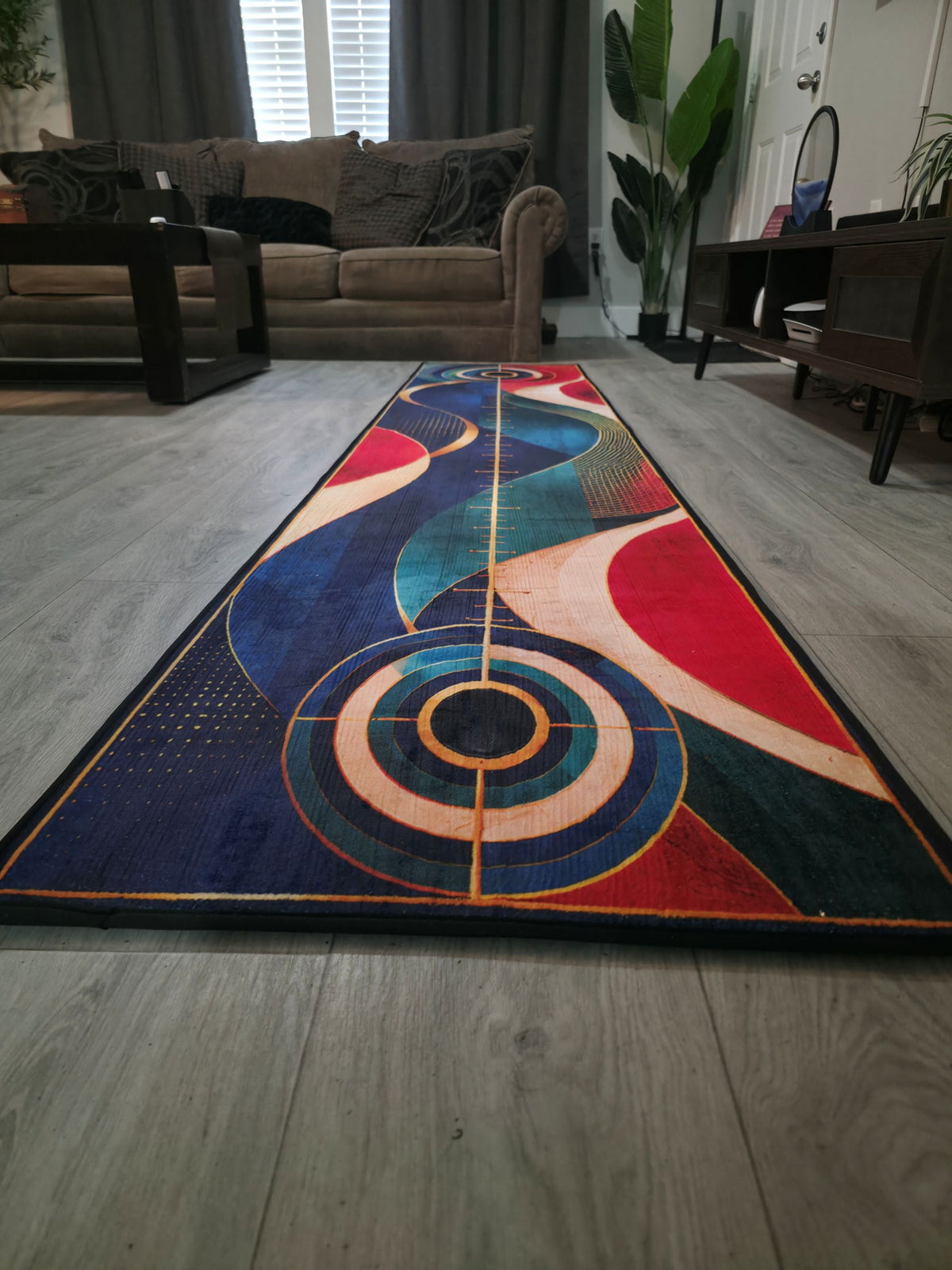
A designer putting rug offers another model. It remains in the office as a runner while the alignment and target are integrated into the artwork. The Eclipse Runner works naturally with dark desks, black metal, and bronze accents. Meridian suits a more expressive mid-century office.
Explore the full designer putting rug collection by room palette before choosing a design.
Make practice support the workday
Putting in a home office is most useful as a brief transition, not a constant distraction. Give the practice a boundary.
The five-putt reset
After a long meeting, roll five putts with attention on posture and start direction. Stop after five, whether the result is good or poor.
The two-distance break
Roll three balls from a short start and three from a longer start. Score only whether each ball begins on line and finishes within a pace zone.
The end-of-day close
Use one ball and complete three full routines. Collect the ball, return the putter to its place, and close the office. The physical ritual can help separate work from the rest of the evening.
Keep the putter secure and the balls in a drawer or small basket. An available surface should not mean loose equipment across the room.
Improve lighting for work and putting
Use layered light rather than one overhead fixture. Combine ambient light, a task lamp, and a softer background source. The practice line should be visible without creating glare on the monitor or sharp reflections on framed art.
Warm light often suits wood, leather, and copper details. Cooler task light may support reading and technical work. If bulbs are adjustable, use a brighter work setting during the day and a warmer setting for the final hour.
Do not depend on decorative LED color to carry the whole room. One controlled accent can be effective; several competing light sources can make a professional office feel temporary.
Design the video-call view
Open the actual camera application and inspect the frame. Remove cords, unbalanced stacks, and objects that appear to touch your head or shoulders on screen. Check that artwork is centered within the visible crop, not only on the wall.
A portion of a runner may appear behind the chair or along the room edge. That can create an understated reveal when the office is seen in person without turning the video background into a product display.
Four office styles for golfers
Dark architectural
Use black, charcoal, walnut, and bronze. Choose linear art, warm task lighting, and one dark runner with controlled metallic detail.
Warm modern
Combine cream walls, oak or walnut, leather, and a black accent. A course landscape and quiet storage keep the room personal without feeling themed.
Mid-century color
Use a restrained mix of ochre, blue, rust, and dark wood. Geometric artwork and the Meridian palette can bring golf function into the visual language naturally.
High-contrast studio
Build around black, white, and one strong color. The Bearcat Runner uses bright red linework for an office that can support a sharper graphic statement.
What to leave out
Avoid placing unused clubs where they block circulation, covering every wall with course logos, or buying several small desk objects before the major elements are resolved. A room feels premium because scale, material, and spacing are controlled, not because every reference is expensive.
Also avoid a practice setup that asks the office to stop functioning. If the chair cannot move or the closet cannot open, the golf line is in the wrong location.
For a broader surface comparison, read Putting Mat vs. Putting Rug: What's the Difference?. For room placement, fold-line relaxation, and care, visit Shipping & Setup. The FAQ covers product dimensions, backing, and common setup questions.
Frequently asked questions
What golf decor looks professional in a home office?
A large course photograph, architectural map, framed scorecard, a few well-made books, or one sculptural object can feel professional. Limit logos and give each object visual space.
Where should an office putting line go?
Use a path that does not cross the chair's movement, door, closet, cables, or main walkway. The side of a desk or a clear line behind it often works better than the center of the room.
Can a putting surface stay out during video calls?
Yes, when it is selected as part of the room. A designer putting rug reads as a runner between practice sessions and does not require the office to look like a temporary training area.
How do I keep golf equipment from cluttering the office?
Use closed storage for balls, gloves, cables, and ordinary accessories. Display only a few objects with visual or personal value, and give the putter one secure location.
What colors work in a golfer's office besides green?
Black and bronze, walnut and cream, charcoal and red, navy and brass, or a restrained mid-century palette can all reference golf through mood and material without using traditional green.
An office that works before it reveals golf
The strongest golfer's office is credible before anyone notices the game. The desk supports real work, the lighting is comfortable, the storage is calm, and the artwork has meaning.
Then the second layer appears: a scorecard with a story, a course hidden in the landscape, or a runner whose geometry becomes a putting line. That order keeps the room modern, useful, and personal.