

How to Practice Golf When It's Too Hot or Raining
Weather changes the golf calendar, but it does not have to stop every form of practice. Heavy rain can close a course or make an outdoor session impractical. Extreme heat can turn a useful hour into an unnecessary risk. In either case, the right response is not to force the original plan indoors unchanged.
Indoor practice works best when it narrows the goal. Putting, routine, start direction, mobility, strategy, and mental rehearsal can all be trained in a controlled space. Full-swing work may require a simulator, net, or professional facility, but a meaningful session does not depend on hitting driver.
This guide offers a practical weather-day plan for golfers who want to keep the game present without turning the home into a training center.
Let safety set the boundary
When heat is the problem, follow current local weather guidance and avoid treating determination as a performance skill. A dangerous heat index, poor air quality, or a body that is not tolerating the conditions is a reason to move inside or stop. When lightning accompanies rain, outdoor practice should wait.
The indoor plan should also be safe. Do not make full swings in a room without proper clearance and a purpose-built containment system. Keep balls away from stairs, glass, pets, and active walkways. Use a putting stroke, mobility work, or strategy review when the home is not designed for impact practice.
The goal is continuity, not imitation. A weather day can improve a part of the game that is often neglected during a normal range session.
Choose one weather-day objective
A focused session needs one primary question. Examples include:
- Can I start the ball on my chosen line more often?
- Can I control three different finishing distances?
- Can I complete my routine without rushing?
- Can I make a clearer decision from difficult course situations?
- Can I improve mobility without fatigue?
Write the objective before beginning. This prevents an indoor session from becoming a random sequence of drills, videos, and equipment changes.
Indoor putting practice for rain or extreme heat
Putting is the most accessible full golf motion for many homes. It requires limited space, produces little noise, and supports useful work on direction, contact, pace awareness, and routine.
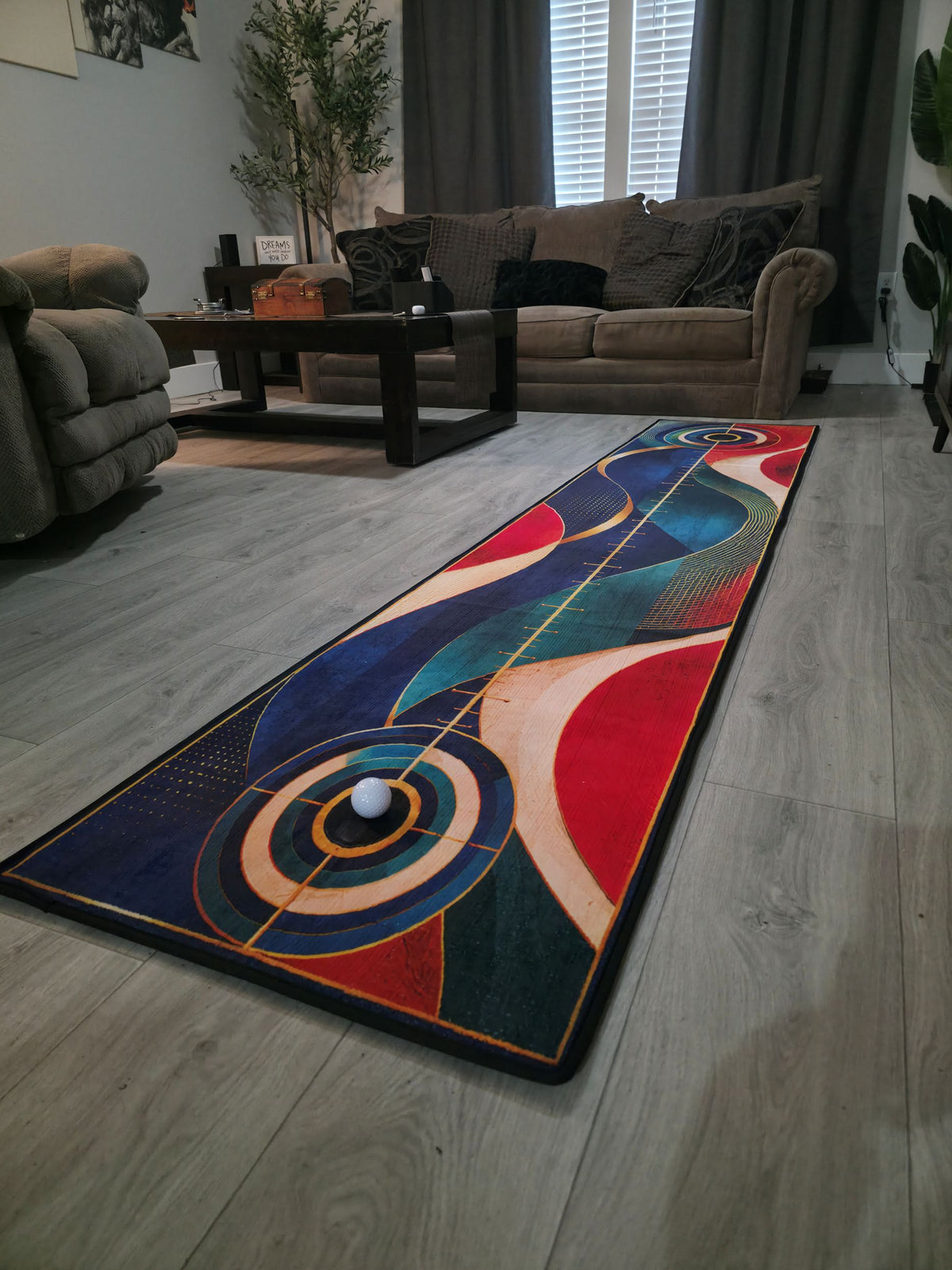
A room-ready surface can make the transition immediate. The Oryan Golf designer putting rug collection is designed as decor first and hidden golf second, allowing practice to remain available without leaving conventional golf equipment across the room.
Start-line gate
Place two coins or flat markers about one foot in front of the ball. Begin with a gate comfortably wider than the ball. Roll ten putts and record how many pass through without touching a marker.
Move the start point rather than making the gate impossibly narrow. The useful information is whether the ball tends to begin left, right, or on the chosen line.
Three-zone pace drill
Create short, ideal, and long finish zones near the target. Roll three balls from three distances. Award two points for the ideal zone and one point for either adjacent zone.
This develops intention around speed without pretending the indoor surface matches every green. Recalibration will still be required on the course.
One-ball routine
Use one ball and complete five putts. Step away between attempts. Choose the line, settle the face, look, and roll. One-ball practice removes the rhythm of repeatedly pulling another ball into place.
Contact and balance
Roll short putts with attention on centered contact and a stable finish. Listen for a consistent strike and notice whether the body moves to guide the ball. Do not chase speed or volume.
A complete 30-minute weather-day session
Minutes 1-5: prepare the room and body
Clear the line, collect three balls, and complete gentle movements for ankles, hips, upper back, wrists, and shoulders. Nothing should feel forced or painful.
Minutes 6-12: start direction
Use the coin gate for three sets of three putts. Change the starting position slightly between sets and record the result.
Minutes 13-20: pace zones
Roll nine balls across three distances. Score the finish zone. If every ball reaches the same area, change the distance rather than adding more balls.
Minutes 21-25: decision practice
Choose three holes from a course you know. For each, describe the intended tee strategy, the side of the green that leaves the safest miss, and the likely putting challenge.
Minutes 26-30: one-ball finish
Complete five putts with the full routine. Write one sentence about the pattern you observed and one adjustment to test on the next outdoor practice day.
Practice golf strategy without swinging
Weather days are useful for decisions that are difficult to rehearse while hitting balls quickly.
Review a familiar course
Use a scorecard or legitimate course map and choose a conservative target for each tee shot. Identify where a miss creates the easiest next shot. The purpose is not to produce perfect numbers; it is to practice selecting a clear plan.
Build a pre-round checklist
Write a short list covering weather, warm-up, first-tee target, hydration, and the one swing thought permitted during the round. A checklist reduces decisions when conditions are distracting.
Revisit three recent mistakes
Separate decision errors from execution errors. A well-chosen shot that was poorly struck requires a different response from a risky target that succeeded only occasionally.
Plan the next practice session
Turn the indoor observation into one outdoor test. If start direction was inconsistent, begin the next green session with a gate. If pace control was weak, spend the first ten minutes on finish zones rather than moving immediately to hole-out drills.
Mobility and recovery on weather days
Golf practice can include the body's ability to move comfortably, but exercises should match the individual. Use familiar, pain-free movements or guidance from a qualified professional when limitations or injuries are present.
A gentle session might include ankle motion, hip rotation, upper-back rotation, and shoulder movement. Work slowly and stop if symptoms appear. Extreme heat days can already place stress on the body, so indoor work does not need to become an exhausting workout.
Hydration still matters indoors, especially after time outside or in a warm home. Follow personal medical guidance and local heat recommendations rather than generic performance advice.
If you have a simulator or net
A simulator can support full-swing practice, but the session still benefits from a narrow objective. Avoid hitting large volumes without feedback. Choose one club, one target, and a fixed number of shots. Rest between sets.
A net requires adequate ceiling height, side protection, safe ball containment, and a room designed for impact. Do not improvise a full-swing station in a living room because rain changed the schedule. A professional indoor facility is the better option when the home cannot support the motion safely.
Make indoor practice belong in the room
The barrier to weather-day practice is often not motivation. It is setup. If equipment must be unpacked, furniture moved, and the room restored afterward, a short session can feel disproportionately difficult.
A designer putting rug changes the sequence by allowing the surface to remain part of the room. Eclipse creates a dark architectural line, Meridian uses an expressive geometric palette, Oryan's Belt brings a black-and-copper celestial composition, and Bearcat offers a bolder black-and-red statement.
Choose the design for the room. The practice function should feel available, not imposed.
For a surface comparison, see Putting Mat vs. Putting Rug: What's the Difference?. For placement and fold-line relaxation, visit Shipping & Setup. Oryan rugs ship folded and include non-slip backing; a separate pad is not normally required. The FAQ covers common questions.
Common weather-day mistakes
Trying to copy an outdoor range session indoors
The home may not support full swings safely. Narrow the session to putting, mobility, strategy, routine, or mental rehearsal.
Practicing without a score or observation
Record gate success, pace-zone points, or one clear pattern. A small measurement gives the session a purpose without turning it into a performance test.
Hitting too many putts from one spot
Repetition can become automatic. Change the start point, distance, or scoring rule after a small set.
Treating indoor speed as universal
Use the surface to practice intention and relative pace. Recalibrate on the practice green before a round.
Ignoring the room's ordinary use
Collect loose balls, keep walkways clear, and choose a setup that does not require the rest of the household to work around golf.

Frequently asked questions
What golf skills can I practice indoors without a simulator?
You can work on putting start direction, contact, pace awareness, routine, course strategy, and familiar mobility. Full-swing practice requires appropriate clearance and containment.
Is it safe to play golf outside when it is extremely hot?
Conditions and individual health vary. Follow current local weather and heat guidance, stop if your body is not tolerating the conditions, and move practice indoors when the environment is unsafe.
What should I practice on a rainy day?
Choose one focused objective such as a start-line gate, three-zone pace drill, one-ball routine, course-strategy review, or gentle mobility session.
Does indoor putting replace practice on a real green?
No. It supports direction, contact, pace intention, and routine. You still need to recalibrate to outdoor speed, slope, and conditions.
How do I make weather-day practice easier to start?
Keep three balls and a putter near a safe line, use a short written routine, and choose a surface that either stores quickly or belongs in the room between sessions.
Keep the habit, change the session
Rain and extreme heat change what is sensible, not whether the day can include golf. A narrow, safe indoor session can improve a skill that receives less attention when the course and range are available.
Choose one objective, work for a defined period, and carry one observation into the next outdoor day. Continuity comes from adapting the practice, not forcing the weather to cooperate.