

How We Used AI to Create a Physical Product That Didn't Exist
Oryan Golf began with a room problem, not a technology idea.
Indoor putting products could make practice convenient, but many of them looked like equipment the moment they entered a living room, office, or apartment. They were useful while a golfer was standing over a ball and visually unresolved the rest of the day. Storing them solved the appearance problem but made practice less immediate.
The question was simple: could a runner belong in the room as decor first, then reveal a real putting function when a ball and putter appeared?
Artificial intelligence helped us explore that question faster. It did not remove the physical work, invent product truth, or replace judgment. It became a tool for organizing possibilities, testing language, comparing directions, and turning an unusual idea into a clearer development process.
This is how AI supported the creation of a physical category - and where the work still had to leave the screen.
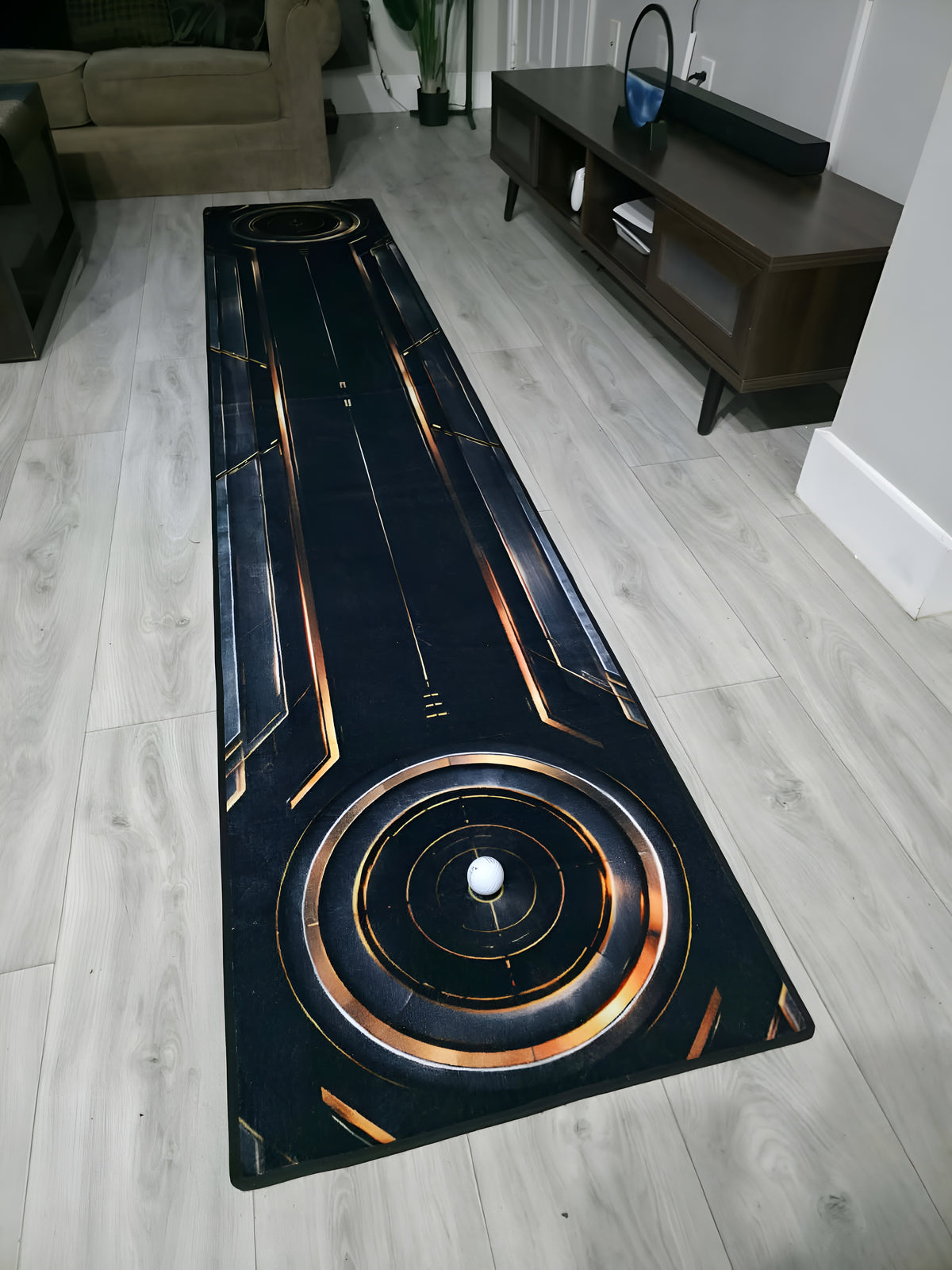
The original problem was visual and practical
The product needed to satisfy two audiences at the same time. A golfer had to recognize a useful practice line. A person who cared about the room had to see a finished runner rather than sports equipment waiting to be put away.
That created a difficult brief:
- The target and alignment could not look pasted onto the design.
- The artwork needed enough structure to support putting without announcing the function immediately.
- The runner had to work with real furniture, circulation, lighting, and room palettes.
- Product language needed to explain the difference without exaggerating performance.
- The reveal had to remain simple: beautiful decor first, hidden golf second.
AI was useful because the problem contained many connected decisions. It allowed us to hold design, positioning, customer questions, and content requirements in one working conversation.
AI helped us ask better questions earlier
Early product work can become attached to the first appealing idea. AI created a faster way to challenge assumptions before they became expensive.
We could ask:
- What would make this look like ordinary golf equipment?
- Which visual cues could serve both composition and alignment?
- How might a spouse, apartment renter, interior-design customer, or serious golfer describe the same object differently?
- What questions would a customer ask about size, storage, backing, fold lines, and care?
- Which claims would require physical evidence before they could be used publicly?
The value was not that every answer was correct. The value was the volume of questions and counterarguments available before a decision was finalized.
AI is most useful in product development when it expands the review, not when it declares the answer.
We used it to clarify the category
Naming matters when a product sits between familiar categories. Calling Oryan Golf a putting mat would make the golf function obvious but understate the design purpose. Calling it only a rug would hide the reason it exists.
The phrase designer putting rug gave both ideas a place. It establishes the object in the home while making the second function understandable.
That category language also shaped the public positioning:
Designer Decor. Hidden Golf.
The order is intentional. The room experience comes first. Putting is the reveal.
For a direct comparison with a traditional category, read Putting Mat vs. Putting Rug: What's the Difference?.
AI accelerated visual exploration, not final approval
Visual exploration is one of the fastest ways to learn what a product should not become. Different line weights, target forms, palettes, and room contexts can expose whether the golf function dominates the artwork or disappears completely.
AI-supported concept work made it easier to compare broad directions. But a concept image is not a physical sample. It cannot confirm surface behavior, edge treatment, color accuracy, backing, scale, or how the runner feels in a real room.
That distinction became a guardrail: generated exploration could guide questions, but public product imagery and claims had to represent actual designs and real product media. Oryan does not use imaginary rugs to substitute for products customers can buy.
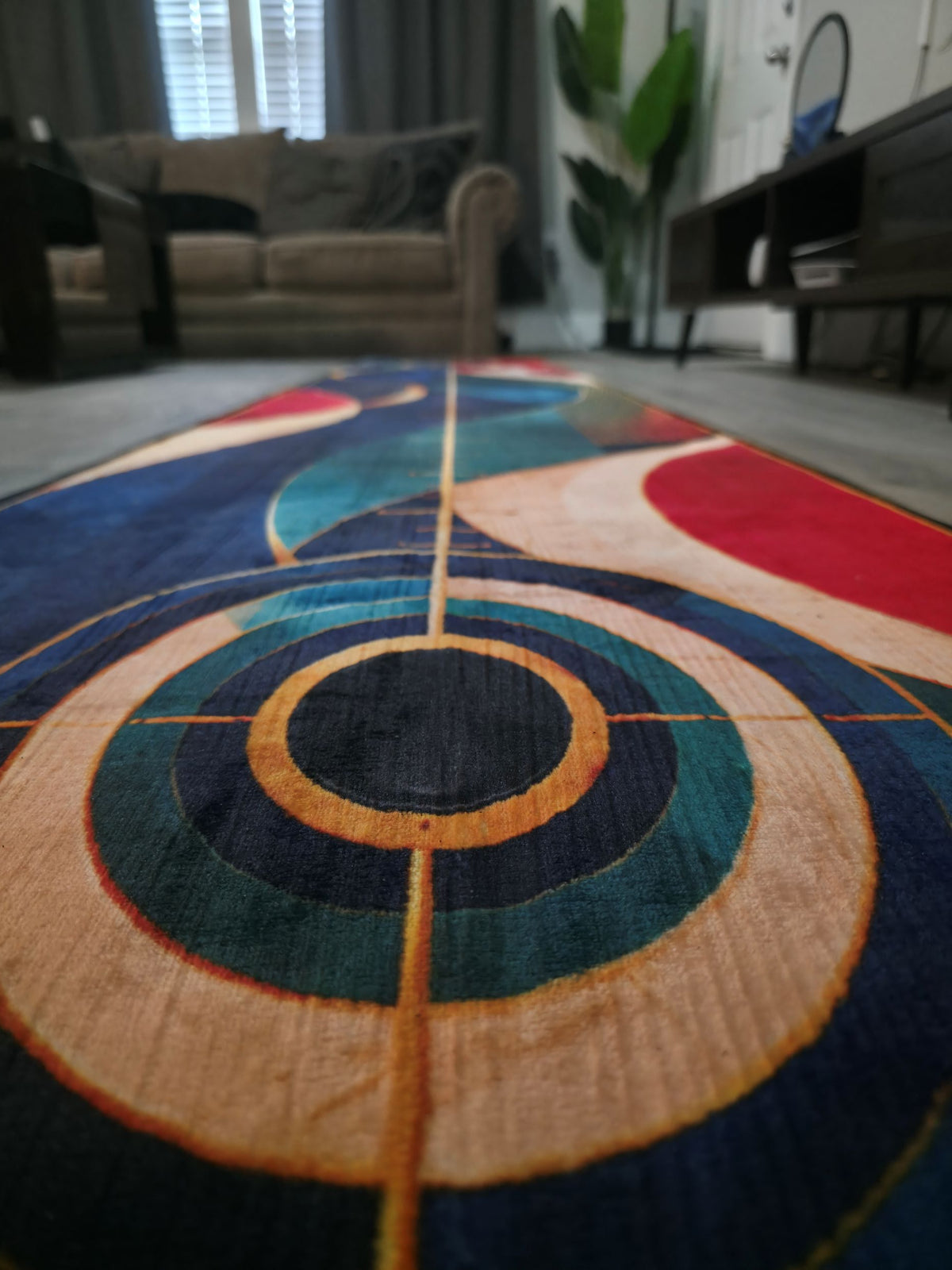
The current designer putting rug collection reflects four different room directions:
- Eclipse is dark and architectural.
- Meridian uses a more expressive geometric palette.
- Oryan's Belt pairs black with warm copper celestial lines.
- Bearcat makes a stronger black-and-red graphic statement.
Each one had to work as a composition before its alignment and target function could feel integrated.
The screen could not answer the physical questions
A physical product becomes real through constraints. Dimensions change the composition. Room lighting changes color. Folding and shipping affect presentation. A ball on the surface reveals details that a rendering cannot.
The physical review had to address questions such as:
- Does the design read correctly at full runner length?
- Is the target easy to understand without overwhelming the artwork?
- Does the ball roll smoothly enough for the intended indoor experience?
- Does the backing help the runner remain appropriately placed?
- What should a customer expect after folded shipping?
- How does the product photograph in a real room from useful angles?
Those questions require samples, observation, and honest communication. AI can organize the checklist and record findings; it cannot manufacture the evidence.
Oryan rugs ship folded. Temporary fold lines relax with gentle reverse rolling and time. They include non-slip backing, so a separate pad is not normally required. Those details belong in Shipping & Setup because they come from the real product experience, not a generated promise.
AI helped connect product development to brand development
Many physical products are designed first and explained later. Because Oryan was creating an unfamiliar category, product and language had to develop together.
AI helped maintain a consistent set of rules across product pages, articles, social scripts, and internal planning:
- Lead with designer decor.
- Protect the reveal.
- Use designer putting rug as the preferred category.
- Avoid language that makes the product sound like a toy or temporary novelty.
- Do not overstate performance.
- Explain setup and care directly.
- Keep every rug name, especially Oryan's Belt, consistent.
These rules are not decoration around the product. They help customers understand what is different and prevent the story from drifting toward a conventional equipment pitch.
It also changed the speed of content production
A new category needs education. Customers may search for putting mats, indoor greens, apartment golf, golf gifts, or golf home decor without knowing that a designer putting rug exists.
AI makes it possible to map those questions, draft useful explanations, build internal links, and create social variations from one source. The process still requires review. Duplicate search intent, unsupported claims, generic writing, and inaccurate images can scale just as quickly as good work.
The rule is simple: automation may increase output, but approval protects the brand.
That is why articles are drafted, checked, previewed, and approved before publication. Social assets are connected to the article but do not replace the underlying useful content.
What AI did well
Organizing complexity
AI kept product truth, customer questions, visual directions, and content tasks connected. That reduced the chance that a decision in one area would be forgotten elsewhere.
Generating alternatives
It provided more options for headlines, category language, room concepts, FAQ structure, and design critique than a single linear brainstorm would produce.
Identifying gaps
It helped surface missing setup information, likely objections, overlapping article ideas, and places where a claim needed evidence.
Repurposing approved truth
Once a statement was verified, AI could adapt it into product copy, an FAQ, an article section, a caption, or a video hook while preserving the central meaning.
What AI could not do
Decide taste
An AI system can produce options and describe patterns. It cannot decide what belongs in a particular founder's home, what feels excessive, or which design creates the right emotional response.
Replace physical testing
Surface behavior, scale, color, packaging, fold lines, and photography require real materials and real rooms.
Create customer evidence
AI cannot fabricate reviews, statistics, demand, or performance claims. Evidence must come from actual customers, analytics, testing, and operations.
Own the final judgment
The founder remains responsible for what is manufactured, shown, claimed, and published. Faster iteration does not transfer accountability.
A practical framework for other founders
1. Begin with a real tension
Define the problem in ordinary language. Ours was the conflict between always-available indoor putting and not wanting golf equipment left out in the home.
2. Ask AI for questions before answers
Use it to identify users, objections, constraints, risks, and evidence requirements. A wider problem map improves later decisions.
3. Separate exploration from product truth
Label concepts as concepts. Do not allow generated imagery or confident language to become evidence.
4. Build a physical verification list
Identify every detail that must be sampled, measured, photographed, or tested before public use.
5. Create brand guardrails early
Write the words, claims, visual principles, and category terms that must remain consistent. This makes AI-assisted work easier to review.
6. Keep a human approval point
Do not let a productive system publish simply because it can. Review quality, accuracy, overlap, imagery, and customer impact.
Frequently asked questions
Did AI design the finished Oryan Golf rugs by itself?
No. AI supported exploration, organization, critique, language, and workflow. Finished products still required human direction, physical sampling, review, and decisions about what represented the brand.
Does Oryan use AI-generated product images?
Public product imagery should represent the actual Oryan designs. Generated exploration is not a substitute for real product media and should not misrepresent what customers receive.
What problem was Oryan Golf created to solve?
Golfers wanted indoor putting to remain available, but many did not want conventional golf equipment left out in a living room, office, or apartment. Oryan combines a designer runner with a hidden putting function.
Why call it a designer putting rug?
The phrase describes both sides of the category: an object selected for the room and an integrated surface for indoor putting. Neither rug nor putting mat alone fully communicates the idea.
What is the biggest risk of using AI in product development?
Confusing plausible output with verified truth. Concepts, claims, imagery, and recommendations still require evidence and accountable human review.
The product had to leave the screen
AI helped Oryan Golf move through questions, alternatives, and content faster. The decisive work still happened when an idea met a full-scale runner, a golf ball, a real room, shipping constraints, and a founder willing to reject what did not belong.
That is the useful role of AI in physical creation: not replacing the material world, but helping a team reach the right physical questions sooner.
The final standard remains simple. The runner should look at home before the ball reveals what else it can do.