

Golf Home Decor Ideas That Don't Look Like Golf Decor
Golf decor often begins with a reasonable intention and ends with a room full of objects that announce the theme too loudly. A framed flag, a shelf of balls, several course signs, and a novelty lamp may each carry a memory, but together they can make a living room or office feel less considered.
There is another approach. Golf can shape a room through color, geometry, landscape, craftsmanship, and function without covering every surface in logos. The goal is not to hide the interest. It is to express it with the same restraint used to choose any other part of the home.
The following ideas work for living rooms, offices, apartments, studies, and golf lounges. They begin with the room, then add golf in ways that feel natural.
Start with the room, not the theme
Before buying golf decor, describe the room without using the word golf. Is it dark and architectural, warm and traditional, colorful and mid-century, or minimal and high-contrast? That answer should guide the palette, materials, scale, and artwork.
A well-designed room can contain golf references without becoming a themed room. Use three principles:
- One clear focal point: Choose a photograph, runner, framed scorecard, or sculptural object to lead the composition.
- Repeated materials: Connect golf objects to finishes already present, such as black metal, warm wood, leather, or copper.
- Useful negative space: Leave enough visual quiet for the meaningful pieces to register.
This is the difference between a collection and a collage. A collection has hierarchy; a collage asks every object to compete.
12 golf home decor ideas with a quieter point of view
1. Use a course landscape as art
Golf courses offer strong landscape photography: long shadows, architectural bunkering, native grasses, and open horizon lines. Choose a print because it works as an image first. A visitor should not need to recognize the course to appreciate the composition.
Black, walnut, or brushed-metal frames keep the presentation clean. If the course is personally meaningful, place the name and date on the back rather than across the front.
2. Frame one scorecard that carries a story
One meaningful scorecard has more presence than a wall of generic memorabilia. Pair it with a single photograph and a wide mat. The resulting piece can mark a personal best, a first round with a parent, or a trip with longtime friends.
3. Choose a runner with hidden golf built into the artwork
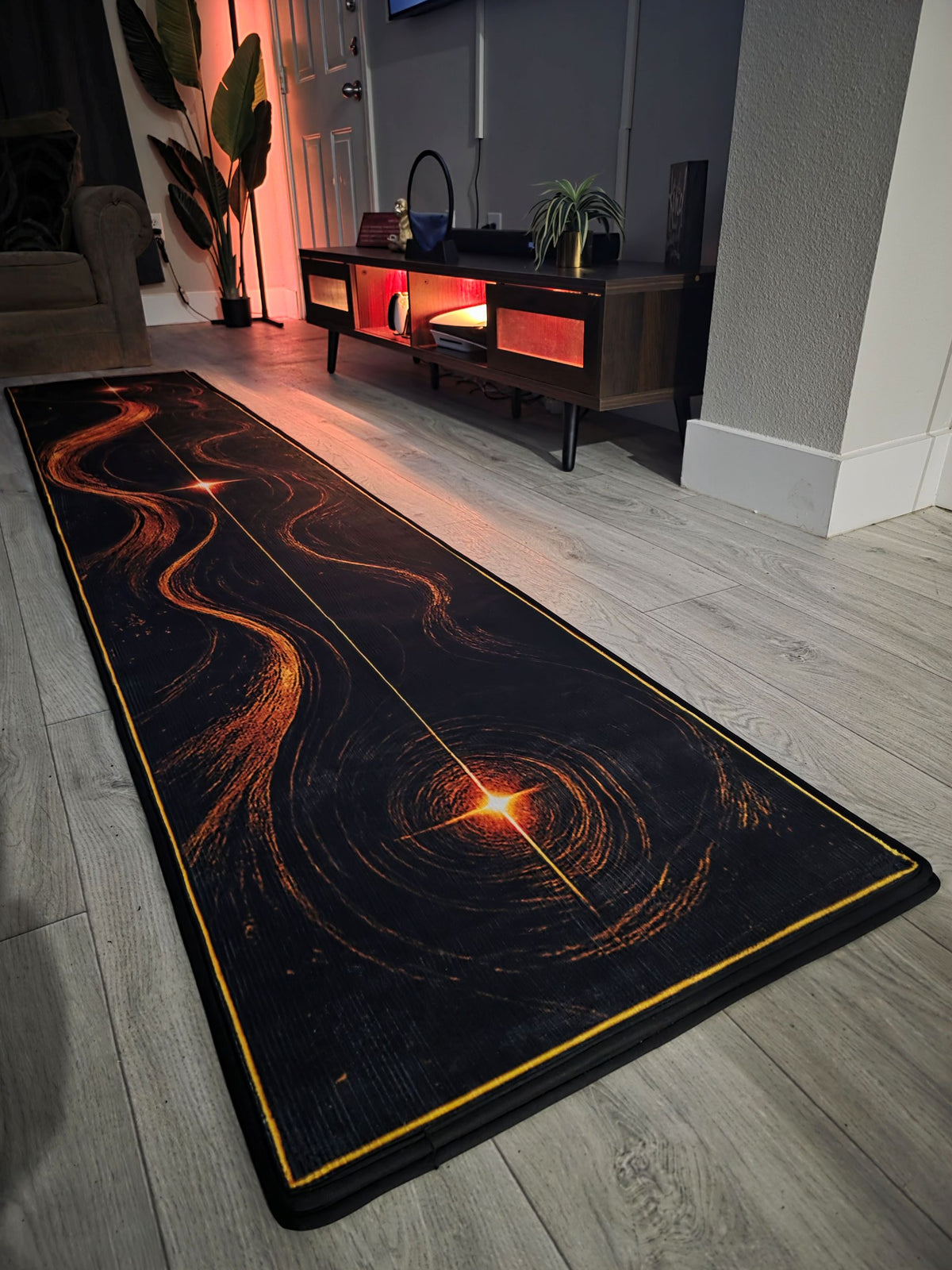
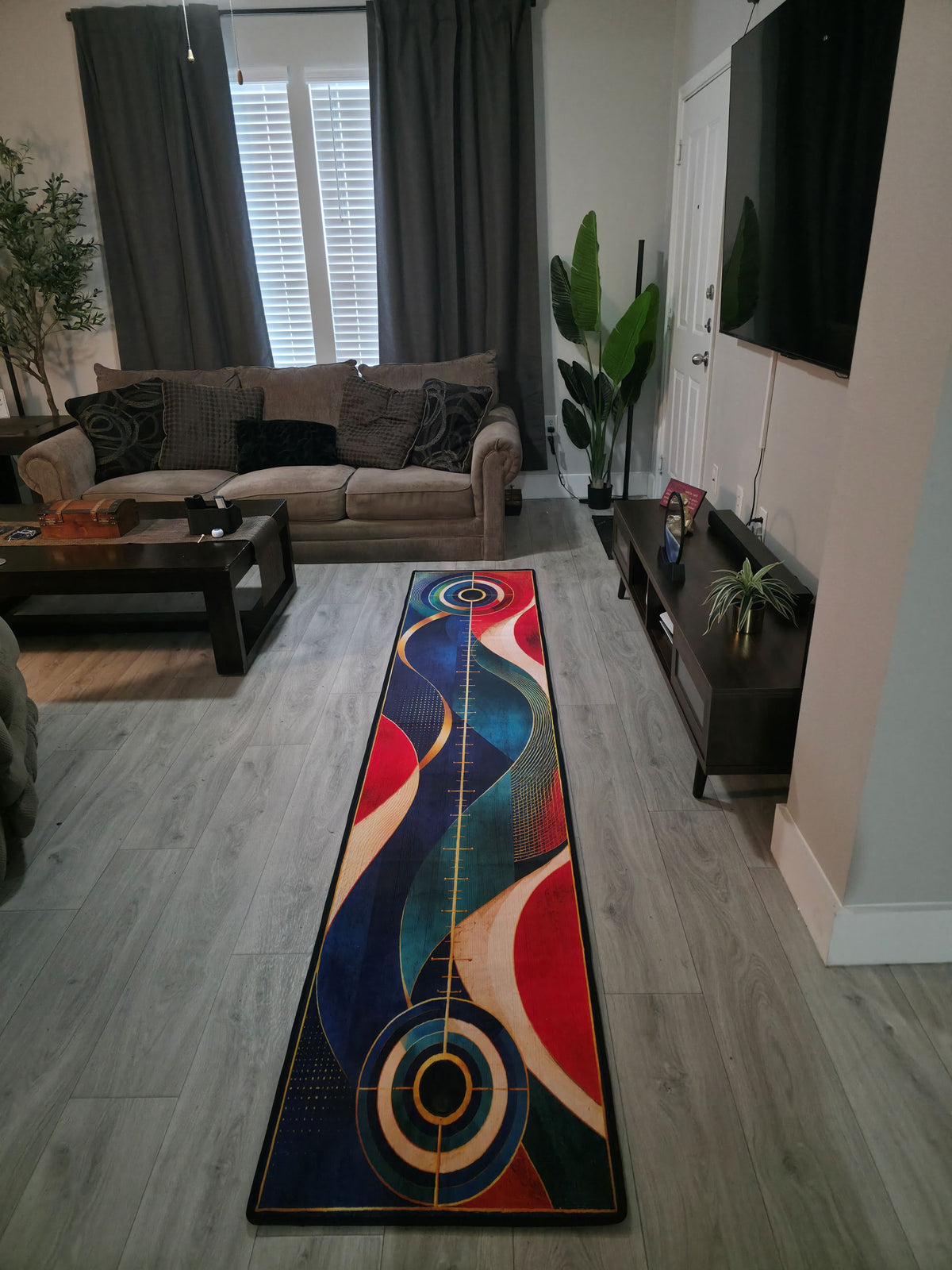
A long runner can define a walkway, connect seating areas, or create a visual axis in a room. A designer putting rug adds a second function without asking the room to look like a training space.
Oryan Golf treats the rug as designer decor first and hidden golf second. Explore the designer putting rug collection by palette and room style. The golf line is part of the artwork rather than applied on top.
4. Display a course map like an architectural drawing
Topographic maps, hole-routing plans, and early course sketches can work like architectural prints. Choose a limited color palette and avoid oversized club branding. A series of two related drawings can fill a long wall without becoming visually busy.
5. Use golf books as part of a real library
Mix golf architecture, photography, biography, and history books with design, travel, and art titles. Stacking every golf book together creates a themed shelf; distributing them by color or subject lets them join the broader room.
6. Treat equipment as sculpture, sparingly
A single vintage putter, beautifully shaped clubhead, or handmade tool can be displayed as an object. Avoid lining up an entire retired set unless the room is specifically designed as a collection space.
Mount the object securely and give it enough empty wall around it. Scale and placement make the difference between sculpture and storage.
7. Build a material palette from the game
Golf already contains a sophisticated material vocabulary: polished metal, leather, dark rubber, fine wool, warm wood, and crisp white. Use those references indirectly through furniture and accessories rather than literal graphics.
A leather tray, dark console, warm timber frame, and bronze lamp can suggest the character of the game without turning the room into a clubhouse replica.
8. Let alignment geometry inspire the room
Straight lines, circles, targets, and long visual corridors belong naturally to both golf and modern interiors. A geometric runner, linear shelf, or circular wall detail can echo putting alignment without spelling it out.
The Eclipse Runner uses architectural bronze-gold lines on black, while Meridian brings more color and mid-century energy. Both demonstrate how function can live inside a graphic composition.
9. Create a compact memory cabinet
Choose a shallow cabinet or one section of built-in shelving for a few meaningful objects: a tournament credential, a ball from a milestone round, a small course model, and one photograph. Label items discreetly.
The boundary keeps the collection intentional and prevents memorabilia from spreading across every surface.
10. Use a restrained color story
Traditional golf green can be beautiful, but it is not required. Black and copper, cream and walnut, deep red and charcoal, or a measured mix of ochre, blue, and rust can all carry golf energy in a more personal way.
Select two dominant neutrals and one accent. Repeating the accent in three small places creates cohesion without making the palette feel branded.
11. Design storage that reduces visual noise
Golf shoes, gloves, towels, and small accessories can quickly make a room look like a staging area. Closed storage near the door or inside a console keeps the daily objects accessible without turning them into decor.
Use open display only for pieces that deserve attention. Everything else should have a calm, convenient home.
12. Include a practice function that can remain in place
Practice becomes easier when it does not require moving furniture or retrieving equipment from a closet. The challenge is making the permanent element belong visually.
A room-ready putting surface solves that conflict by functioning as a runner between sessions. Read Putting Mat vs. Putting Rug: What's the Difference? for a direct comparison of the two approaches.
Room-by-room guidance
Living room
Keep the golf reference integrated with the main furniture plan. A runner, one large landscape, or a low cabinet of meaningful objects is usually enough. Avoid placing a practice target where it competes with the television, fireplace, or primary artwork.
Home office
The office can support more personal detail because it is already a working room. Use one framed course image, quiet desk accessories, closed storage, and a long visual line beside or behind the desk. Golf should add rhythm, not distraction.
Apartment
Choose objects that perform two jobs. A runner defines circulation and supports putting; a storage bench holds gear and adds seating; a framed map supplies both memory and artwork. Fewer, larger pieces generally make a small room feel calmer than many tiny references.
Golf lounge or simulator room
Begin with acoustics, lighting, seating, and circulation. Once those functions work, add design through materials and art. The simulator is already a strong golf signal, so the rest of the room can be more restrained.
A simple editing test
When the room feels too themed, remove half the explicitly golf-shaped objects and look again. Then ask:
- Does the focal point remain clear?
- Are the best memories still represented?
- Does every displayed object have enough space?
- Would the room still feel complete to someone who does not play golf?
If the answer to the last question is yes, the golf references are probably integrated rather than imposed.
For rug placement, fold-line relaxation, and care, review Shipping & Setup. Oryan rugs have non-slip backing, so a separate pad is not normally required. The FAQ covers common room and product questions.
Frequently asked questions
How do I decorate a room for a golfer without making it look themed?
Start with the room's existing style, then add one or two meaningful golf references through art, materials, or function. Keep logos limited and allow visual space around displayed objects.
What colors work for modern golf decor?
Black and warm metal, cream and walnut, charcoal and red, or a measured mid-century palette can all work. Golf green is optional. Choose a palette that already suits the room.
Can golf equipment be used as decor?
Yes, but select one object with shape, history, or craftsmanship worth displaying. An entire set of unused equipment usually reads as storage unless the room is designed as a collection space.
How can I include indoor putting without changing the room?
Use a surface designed to remain in place as part of the decor. A designer putting rug combines a runner format with integrated alignment and target artwork.
What golf decor works in a small apartment?
Prioritize dual-purpose pieces, closed storage, one strong artwork, and a restrained palette. Avoid many small novelty objects, which can make the room feel crowded.
Let golf feel lived in
The most convincing golf home decor does not look newly themed. It looks accumulated with judgment: one image from a memorable place, one object with a story, materials that feel connected to the game, and a function that fits daily life.
Design the room first. Golf will still be visible, but it will feel like part of the person who lives there rather than a label applied afterward.